What I learnt on a 3-month meditation retreat (Part 1)
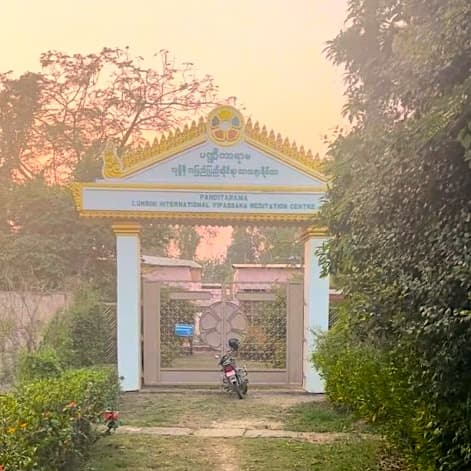
From December to end of February I spent 11 weeks at Panditarama International Vipassana Meditation Centre in Lumbini, Nepal. Nestled close to the Indian Border, an important crossroad in between India and the Himalayas, within South Nepal’ cement industry hub, the pilgrimage site is quite the cultural hodgepodge. The planned zone, also a UNESCO World Heritage and biodiversity hotspot, is famous for being the birthplace of Siddartha Gotmana, the historical Buddha. Pilgrims from all over Asia (and now the world) have been travelling to this holy site for millennia, with the emperor Ashoka Emperor Asoka in 249 BC building a huge pillar testifying that the Buddha was born there in 623 BC. Many vestiges, such as monasteries, stupas and others, have been found in the area corroborating that pilgrims have been visiting the area since the 3rd century BC to the 15th century AD.
I didn’t choose Lumbini for it’s historical significance, nor did I need to go East to find myself. It was simply the only and cheapest place I knew I could practice Vipassana meditation for a long undisturbed time, under sound guidance and provided the right food and accommodation. Early in the same year, after having to travel to India for a friend’s wedding in January, I had already done a short 12-day retreat at the centre. Now, 10 months later, I was ready for 77 days.
What I learnt from mischievous monkeys and the mind, from tracking my meditation in a spreadsheet, eating bland porridge, and spending countless hours working hard without doing anything, will be attempted to describe using mere words below and the following piece.
Have your shit together (as much as possible)
A couple of months before embarking to Nepal I had asked my teacher, the only person I personally knew whom had done a long (3 month retreat), if he can give me some advice. The first thing he clarified was that anything he’d say was based on his own subjective experience, that it may be completely different for me. However, one thing he did mention was that it had helped him to have left from a prepared place, that his coaching business was running well and personal life was in order. This made me think I got to tie up the loose ends in my life before going on retreat. So I decided to quit my consultancy job, prepare some social media content before I leave, finalise my website and leave on good terms with my partner.
What ensued was going from work to a 12 day hiking excursion with a friend in the Himalays right before the retreat. The social media content was finalised whimsically on the go, the website was far from finished and I had to break up with my then partner on the phone two days before going silent for months. As one may imagine, arriving in the calm and tranquil setting of Panditarama International Meditation Centre in Lumbini Gardens, Nepal, the storm in the mind was brewing to a full-fledged cyclone. As with any body of water though, when winds subside, currents weaken, the water gradually settles to a clear and calm surface.
A flowerbed free of pests and toxins, getting the right nutrients, water and sun, will flourish all by itself
There were about 30 other full-time retreatants at the centre at the time of my arrival, a mix of men and women, mostly ranging in between the late 30s and 50s, from all over the world. If these people could just meditate at home, why would they go through the trouble of flying half-way around the world to sit in silence all day long? Apart from the early morning rituals of our neighbours, the bustling tourists on weekends, the occasional blaring music from a nighttime picnic party, and the rare sight of a foraging monkey, it was pretty quiet and laidback. There was plenty of space to move around the small centre and it wasn’t too busy to be distracted by others doing their walking meditation at snail’s pace.
Daily life was actually quite uneventful. Those who have been on a meditation retreat will know that reading the ingredients on the back of a shampoo bottle or watching a bee extract nectar from a flower, can be the most interesting thing to take place all day. Routine here at the centre was pretty much dictated by the breakfast and lunch gong at 6am and 11am respectively, then there were short interviews with the teachers and live Dharma talks 4 days a week and that was it. No bells calling you, no rigid schedules or set of rules to adapt to. The only things prohibited were idle chatting or lying, stealing, taking intoxicants, sexual misconduct and killing. Reading or mobile phone use, was strongly advised against. All of which didn’t seem so difficult as everyone was quiet, kept to themselves and meditated all day. The food also agreed with me, it seemed I had everything I needed.
Nevertheless, the mind was filled with endless machinations, more often than not in the guise of optimisation, dictated by deep-seeded beliefs. One such belief, was that I ought to stay in optimal health throughout the retreat to get the most out of it.
Letting go of beliefs
In all fairness I was not the only one hoarding hard boiled eggs for lunch, consuming vitamins or adding protein powders to my porridge. It was all over the dining hall, even the Sayadaw, or head monk, had a huge stack of vitamins. ‘Was peanut butter or yoghurt a richer protein source? Would I get more iron from dal or tofu? Can I digest porridge or bread better? Today they have crunchy peanut butter, so I can have two slices of bread instead of one, hurray! But only half a banana, otherwise I’ll be too full...’. These were all typical ruminations triggered nearly every time I entered the dining hall, seeing the food displayed in front of me.
It didn’t help that they guy sitting next to me consistently loaded his plate with huge portions, while mine got smaller and smaller. In our utter verbal silence, we couldn’t help but notice and analyse each other plates. I’m sure we both thought we were right and the other wrong (we did actually start talking a bit before he left and it turned out he was a little preoccupied I’d be in a caloric deficit, which of course worried me even more, so I started piling up the rice again).
Anyway, caloric deficit or not, lack of iron or not, it is arguably all tied to our belief systems and (imagined) need (or insecurity) to be optimal. Of course, we need calories and iron to function, a real deficit is no joke, however, was I really in deficit or just scared of being in one? It hit me, why did I need to be in optimal health just to sit in silence or walk around my bungalow? Was it merely my ego that wanted an optimal mind/body state to be productive, that wanted progress, that wanted X to get Y? Food and the optimisation of it, was a pretty much constant topic for me, which only really gained less importance towards the end of the retreat, as I, realising the futility of it, could let go (some of the time).
Relinquish control
I’d be lying if I knew how to always let go, how to relinquish control and truly surrender on demand. A third into the retreat, I started tracking the quality and length of my meditations on a self-written spreadsheet. A micro-managed attempt to fix my, what seemed stagnating, meditation progress. It could also have been a vain attempt to show off to the Sayadaw, bolstering his image of me, as I quickly realised; all a useless attempt at maintaining (the illusion of) control. There were other moments later on in the retreat that I did manage to just sit back and enjoy the process without doing anything. Although, as soon as I was in the airport on the way back, I unconsciously wandered in a health store and bought myself some omega-3 and multivitamins... It’s funny how one may expect to walk out of a retreat and be rid of all one’s shackles…how wrong I was…The body or my regard of it, was still a big one…
In Buddhism the body is often disregarded. Eating is seen as the functional act to sustain minimal physical health and spiritual practice, rather than a source of indulgence or path to beauty. This was hard for me to swallow. To me, the health and appearance of the body was paramount. As a hobby triathlete, I had to squeeze out every extra watt from my body. Now all of a sudden, I was told to forget about it, to abandon control over the body? Seeing other people get sick, I wanted to prevent illness, seeing me lose weight I wanted to stop muscle loss, feeling full or sluggish I wanted to feel light and fresh. The need for control, for wanting to change the outcome of a current situation, was rife.
If we are not in control, then who or what is taking actions?
The free will debate could be an article of its own and not something to be covered in detail today. Imagine though, you are at the supermarket and hesitating in between two different cereal types. Then, finally you choose one. What made you choose the Special K instead of the Frosties? Was it your ‘free will’ or was your will determined by other conditions you may have not been even aware of? You might, in that moment, decide to choose the Special K, but what factors guided your decision? Maybe you have heard they are healthier, or have less sugar, maybe you want to be healthier, or perhaps you have tried them before and simply like the taste, etc.. There could be hundreds of reasons…
Early on in the retreat the Sayadaw kept asking us to observe correlations in our day-to-day activities, in between the meditations. There was so much to notice; e.g. how 11am approaches and somehow something instinctively knows, even without seeing the time, that lunch is approaching, walking towards the dining hall, stepping up the pace slightly once the gong rang, how we started salivating upon entering the hall and seeing the food.
There were so many correlations; seeing a fellow male sitting close to you in the hall, still sitting as still as a statue, while you are squinting open your eyes contemplating to getting up and leaving, but then deciding to stay a bit longer. You see pizza displayed on the lunch buffet and all of a sudden you have loaded up your plate with much more than you normally would have, the weather is nice and you decide to do your walking meditation outside rather than indoors, etc...
If our choices are influenced by current context and prior conditions, then who or what am I?
Fritz is not a fixed entity. With no one to prove anything to (except maybe the Sayadaw), no social peer group to interact with (apart maybe the fellow meditators sitting in the hall or creeping around the centre), no external content to influence one’s perspectives (except for the dharma talks), I was wondering who am I? Sometimes as I was just standing in my room, silently looking through the wall into space, not a thought in my mind, probably appearing like a vegetable from the outside or as if in a waking coma, I was no one. Was there just experience, shaping the next experience continuously? Were there just external sensory inputs, internal flesh and bones, a mass of biochemical processes, a brain in a skull, a mind in I don’t-know-what? During such moments of sheer emptiness there was no intention or thought, there was nothing except a pure state of being. Then maybe, all of a sudden, an itch, a need to pee, hunger or whatever came creeping in. Ok biological immediate necessities. Time for food, hunger, conditioned intentions to eat, loading of plate in sight/smell of good food, feeling full, conditioned intention of wanting to meditate effectively, stomach to full to be able to, expectation or objective of prior intention not met, frustration ensued. Or, feeling light and energetic again, elation, intention to do a longer meditation, and so on.
Perhaps the interplay between experiences, feelings and intentions become clear. We hear the gong for food, become hungry, intend to eat, etc. We have covered this above, but then if Fritz is merely blindly following one intention based on something else, is he just an inanimate zombie? What else guides this zombie? Current conditions and prior happenings. Not only momentarily, or pre-momentarily, but possibly stretching back to thousands of years? Where does it end? Evolution makes us adapt best to our current environment to be able to survive in it. That’s all, survival is the goal, possibly the sole raison d’être. Again, am grossly oversimplifying here and could write a whole other blog about this…
So much is still left to say, time is ticking, stay tuned for Part 2 coming up, to learn why monkeys resemble the mind, what eating bland porridge can teach you and how to not lose one’s sanity.